

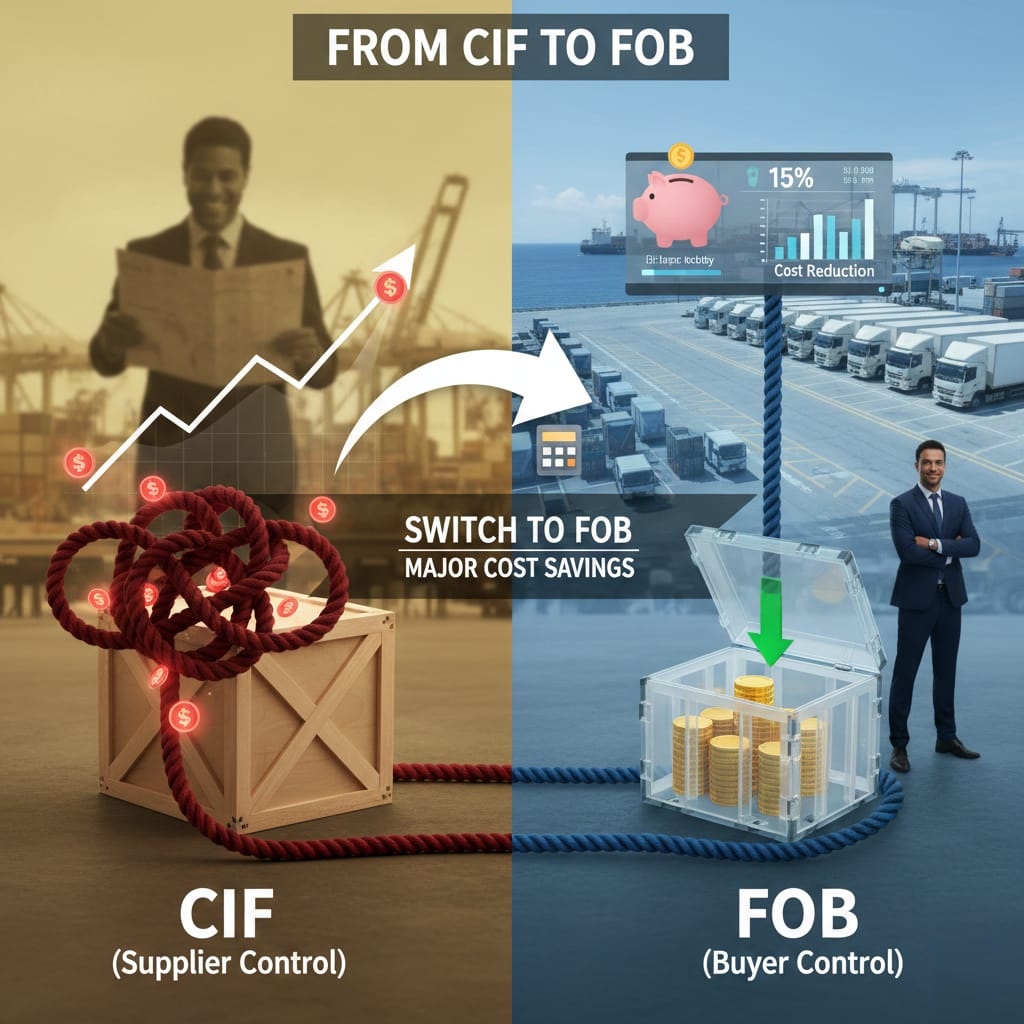
Many companies still import under CIF terms because it feels easier:
The supplier arranges freight and insurance, and the cargo arrives at your port with minimal involvement from your side.
But that “comfort” often comes with higher hidden costs and less control.
Switching from CIF to FOB is not just a logistics adjustment — it’s a strategic cost management decision that can significantly impact your Total Landed Cost.
The Real Difference: Who Controls the Freight Money?
| Aspect | CIF | FOB |
|---|---|---|
| Freight booking | Supplier | Buyer / Buyer’s forwarder |
| Freight cost | Defined by supplier | Negotiated by buyer |
| Insurance | Supplier | Buyer |
| Control over shipping line | Limited | High |
| Cost transparency | Low | Full visibility |
Under CIF, freight cost is usually embedded in the material price.
The supplier is not a logistics company, yet they often:
- Add margin on freight
- Choose lines based on convenience, not efficiency
- Have little incentive to reduce logistics cost
Where Does the Real Saving Come from with FOB?
1️⃣ Eliminating the Supplier’s Freight Markup
In many CIF deals, the supplier loads:
- Freight
- Conduct
- Insurance
- Plus a markup (often 5–20%)
Under FOB, you pay market freight rates, not supplier-added logistics profit.
2️⃣ Stronger Negotiation Power as a Company, Not a Single Shipment
When your company imports multiple materials from Asia (China, India, Vietnam, Thailand, etc.), you can:
- Establish rate agreements with freight forwarders
- Fix rates for a defined period
- Consolidate shipments
This typically reduces cost per container compared to supplier-controlled freight.
3️⃣ Control Over Transit Time = Lower Indirect Costs
Freight is not only about price — it’s about time.
Delays mean:
- Higher safety stock
- Production pressure
- More working capital tied in inventory
With FOB, you can choose:
- Faster shipping lines
- Better schedules
- Less congested routes
Which supports leaner inventory and better planning stability.
A Practical Case: ~15% Freight Cost Saving
In a real sourcing case involving raw materials from East Asia, shipments were previously under CIF terms.
After reviewing market freight levels, it became clear that the supplier’s built-in freight cost was above actual market rates.
The switch to FOB was made while keeping the same supplier, and freight was managed directly through a contracted forwarder.
Results:
✔ Around 15% reduction in average freight cost
✔ Similar shipping lines and service level
✔ Full control over schedules
Impact on Final Material Cost
Example:
| Item | CIF | FOB |
|---|---|---|
| Material price | 1,000 USD | 1,000 USD |
| Actual freight | (embedded) = 200 | 170 |
| Total | 1,200 | 1,170 |
Saving: 30 USD/MT
For an annual volume of 3,000 MT:
👉 90,000 USD yearly saving — without negotiating the material price itself.
FOB Elevates Procurement from Operational to Strategic
Under CIF, procurement is mainly:
Receiving goods.
Under FOB, procurement becomes:
Managing logistics cost as part of total value.
This shifts the role from purchase execution to Total Landed Cost ownership.
Is FOB Always Better? Not 100%
CIF may still make sense when:
- Volumes are very small
- The company lacks logistics capability
- The supplier has an exceptionally strong freight contract
But for regular imports from East Asia, FOB often means:
More control + Higher transparency + Lower cost
Conclusion
Changing from CIF to FOB is:
- A financial decision
- A control decision
- A strategic supply chain move
Sometimes, simply changing the shipping term can deliver savings equal to a full price negotiation on the material itself.
Bassem Amin
Foreign Procurement Manager | EFCO | OW Group



Leave feedback about this