

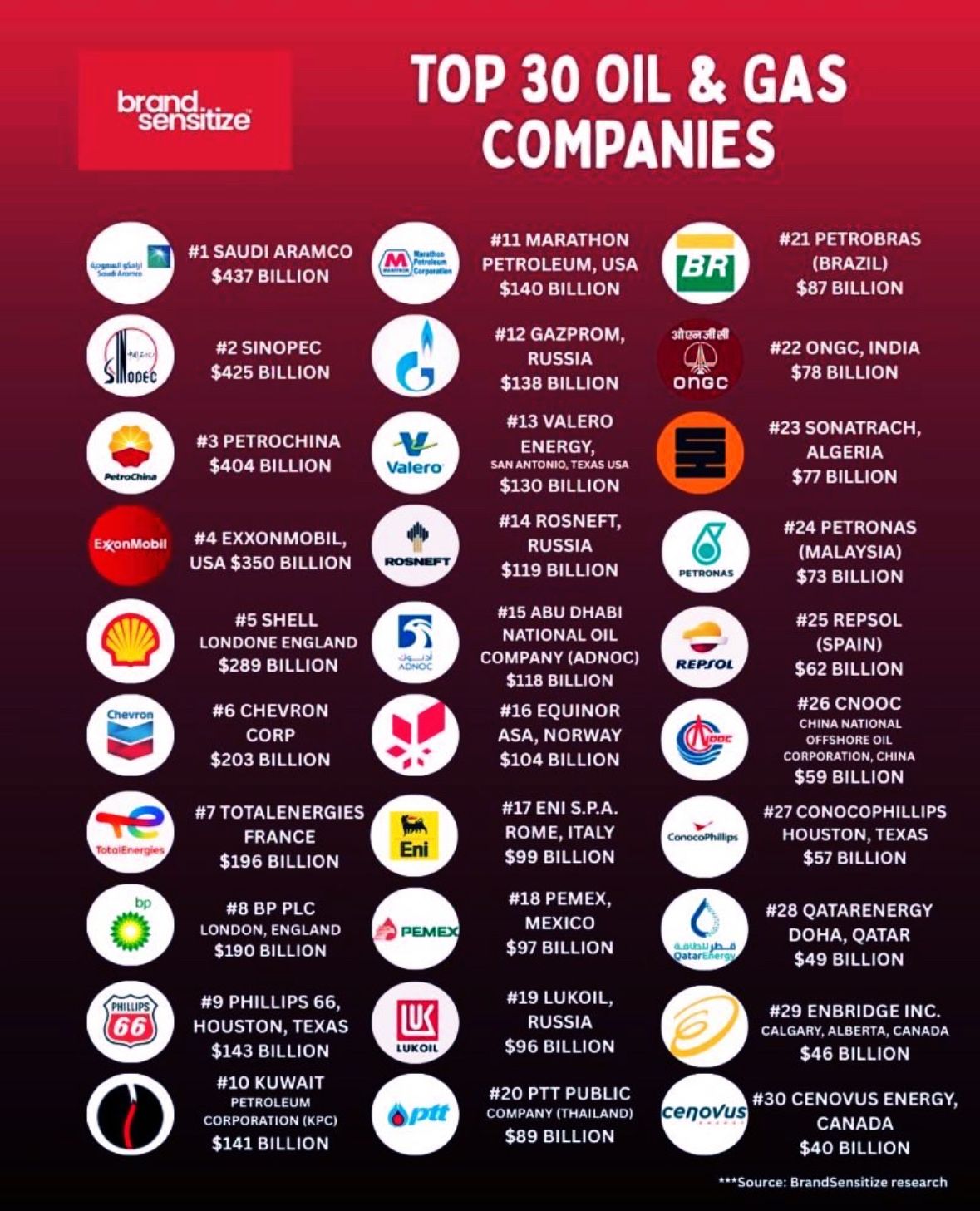
Top 30 Oil & Gas Companies — What This Ranking Really Shows
At first glance, this ranking of the world’s Top 30 Oil & Gas companies appears to measure industry leadership.
In reality, it reveals something more fundamental: how power, volume, and state influence shape global energy markets.
Important clarification:
The figures shown represent annual revenues, not market capitalization.
This distinction is critical.
⸻
Revenue dominance reflects state control
The top of the ranking is overwhelmingly led by National Oil Companies (NOCs) such as:
• Saudi Aramco
• Sinopec & PetroChina
• ADNOC, Gazprom, Petrobras, Pemex
These entities:
• Control strategic reserves
• Operate as fiscal pillars of their countries
• Prioritize production scale and national revenue over capital efficiency
High revenue signals resource control, not necessarily profitability or investor value.
⸻
International majors compete on a different axis
Companies such as ExxonMobil, Shell, Chevron, BP, TotalEnergies rank lower by revenue, yet often outperform on:
• Capital discipline
• Free cash flow generation
• Governance and transparency
• Shareholder returns
Financial markets reward efficiency and predictability, not volume alone.
⸻
A structurally divided global energy system
This ranking clearly illustrates a dual architecture:
National Oil Companies (NOCs)
→ Control reserves and geopolitics
→ Anchor national budgets
→ Drive long-term supply security
International Oil Companies (IOCs)
→ Optimize capital allocation
→ Drive technology and operational efficiency
→ Interface with global financial markets
Understanding this split is essential for traders, investors, policymakers, and strategic partners.
⸻
Strategic takeaway
In global energy, size indicates control — not quality.
True strategic advantage sits at the intersection of capital, governance, logistics, and market access.
This is where informed decision-making outperforms headline rankings.
⸻


Leave feedback about this