

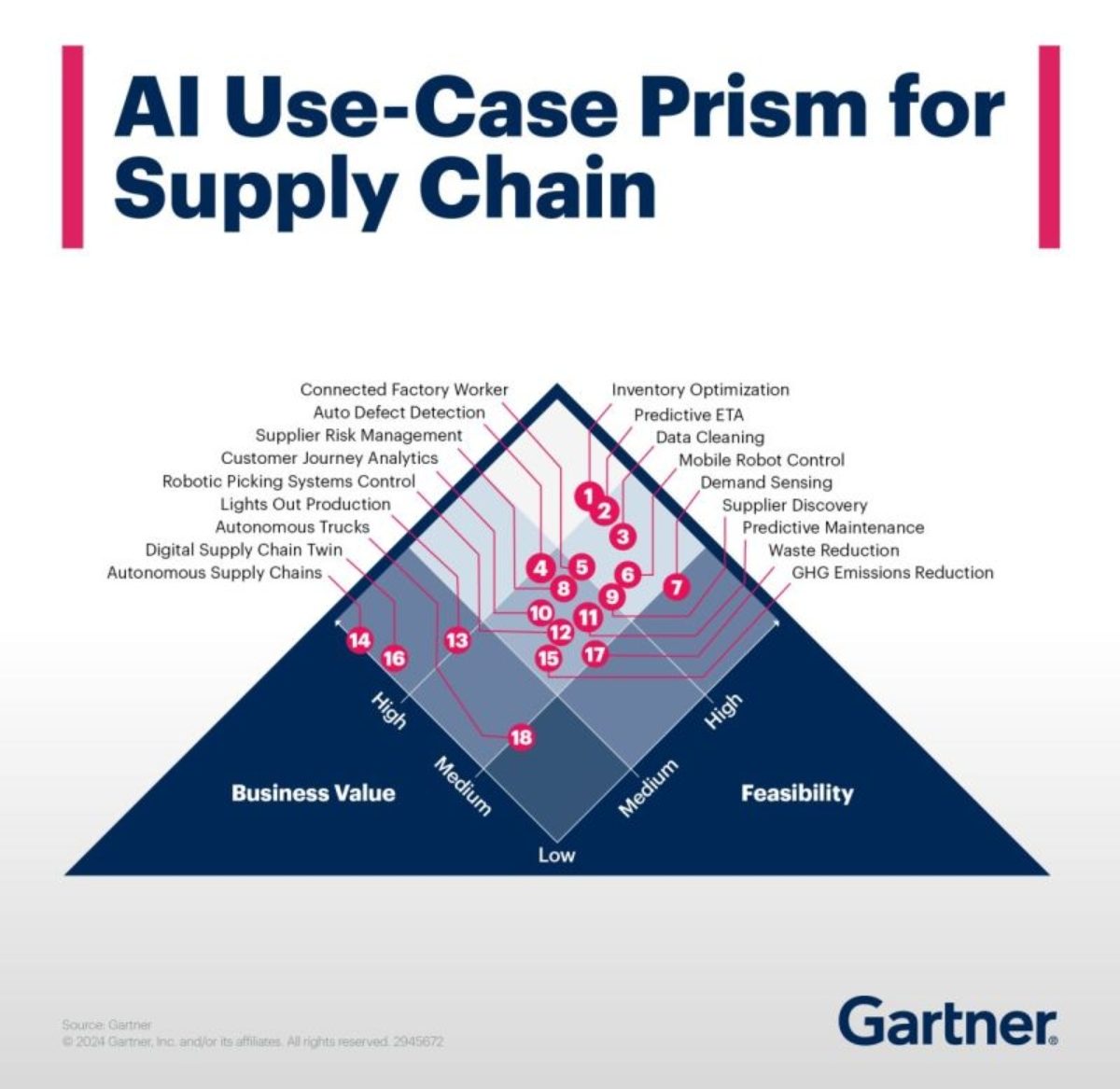
AI Use-Case Prism for Supply Chain By Gartner
Artificial intelligence is rapidly transforming supply chain management, offering solutions that enhance efficiency, resilience, and innovation. Gartner’s AI Use-Case Prism for Supply Chain highlights the most impactful applications of AI across planning, sourcing, manufacturing, delivery, and customer fulfillment. By evaluating business value and feasibility, the report provides a roadmap for organizations to prioritize AI adoption.
Key AI Use Cases
The prism identifies a wide range of AI applications, from foundational improvements to advanced autonomous systems. Among the most notable are:
Inventory Optimization – Using AI to balance stock levels, reduce waste, and improve service.
Predictive ETA – Enhancing delivery accuracy by forecasting arrival times with real-time data.
Data Cleansing – Ensuring data quality and reliability, a critical enabler for all digital initiatives.
Auto Defect Detection – Leveraging computer vision to identify product defects early in production.
Connected Factory Worker – Augmenting human roles with AI-driven insights and safety monitoring.
Mobile Robot Control & Robotic Picking Systems – Automating warehouse operations for speed and accuracy.
Demand Sensing – Predicting customer demand patterns to improve planning and responsiveness.
Supplier Risk Management & Supplier Discovery – Assessing supplier reliability and identifying new partners.
Predictive Maintenance – Anticipating equipment failures to reduce downtime and costs.
Lights Out Production – Fully automated manufacturing environments with minimal human intervention.
Digital Supply Chain Twin – Creating virtual models to simulate and optimize supply chain performance.
Autonomous Trucks & Supply Chains – Pioneering end-to-end automation in logistics and operations.
GHG Emissions Reduction & Waste Reduction – Applying AI to sustainability goals, cutting emissions and minimizing waste.
Customer Journey Analytics – Understanding customer behavior to improve fulfillment and satisfaction.
Business Value and Feasibility
Gartner’s scorecard evaluates each use case against efficiency gains, service improvement, revenue growth, data availability, cultural readiness, talent, and technology. High-value, high-feasibility applications such as predictive ETA, data cleansing, mobile robot control, and autonomous trucks stand out as immediate opportunities. Meanwhile, more complex initiatives like autonomous supply chains and digital twins promise transformative impact but require greater investment and organizational readiness.
Why It Matters
AI in supply chain is no longer experimental—it is becoming a competitive necessity. Companies that strategically adopt high-value, feasible use cases can unlock efficiency, improve customer service, and drive growth. At the same time, investing in advanced applications positions organizations for long-term leadership in autonomous and sustainable supply chains.
Written by: Eng. Yara Hossam Helmy
Founder Supply Chain Community
Influential leader in the field of logistics & supply chain



Leave feedback about this