

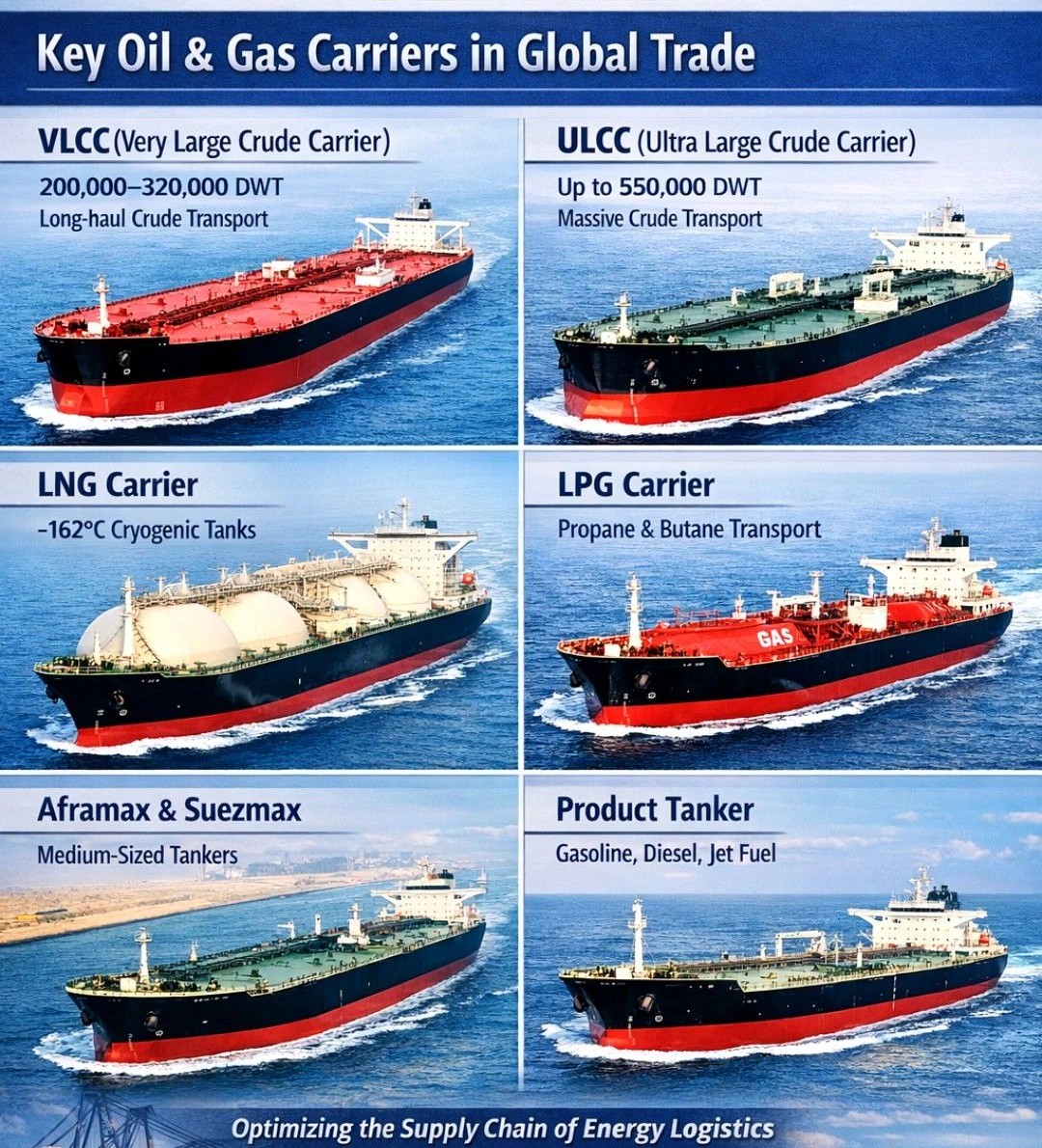
When we talk about global energy logistics, shipping plays a critical role. Different types of carriers are designed based on cargo type, volume, and route constraints.
Let’s simplify the key oil & gas carriers
🔹 VLCC (Very Large Crude Carrier)
Massive tankers exceeding 200,000 DWT (often up to 320,000 DWT).
Primarily used for long-haul crude oil transportation between continents.
🔹 ULCC (Ultra Large Crude Carrier)
The giants of the sea
Capacity can reach up to 550,000 DWT, designed for transporting extremely high volumes of crude oil.
Less common today due to port limitations.
🔹 LNG Carrier (Liquefied Natural Gas)
Highly specialized vessels equipped with cryogenic tanks (membrane or Moss type).
They maintain natural gas at around -162°C to keep it in liquid form.
🔹 LPG Carrier (Liquefied Petroleum Gas)
Used to transport gases like propane and butane.
Cargo is either pressurized, refrigerated, or semi-refrigerated depending on vessel type.
🔹 Aframax & Suezmax Tankers
Medium-sized tankers optimized for specific trade routes:
• Aframax – Ideal for regional trades
• Suezmax – Designed to pass through the Suez Canal
🔹 Product Tankers
These carry refined petroleum products such as:
– Gasoline
– Diesel
– Jet fuel
Why it matters:
Each vessel type is a strategic decision in supply chain planning—balancing cost, route constraints, and cargo requirements.
In logistics, choosing the right vessel is not just transportation… it’s optimization.
Written By:
Eng.Yara Hossam Helmy
Founder Supply Chain Community

Leave feedback about this